Arch of Constantine Self-researched
Rome, Italy
Artworks
Spandrel Victories and River Gods Self-researched
The spandrels (triangular areas flanking the arches) are carved with Victories bearing trophies and palm branches on the central arch, and river gods on the lateral arches. These figures follow traditional Roman triumphal iconography and provide visual continuity between the Constantinian and reused elements.
Marcus Aurelius Relief Panels (South Side) Self-researched
Four rectangular panels on the south side of the attic, from the same Antonine monument. From left to right: a captured enemy chieftain led before the emperor, another scene of prisoners presented, the emperor speaking to the troops (adlocutio), and the emperor sacrificing a pig, sheep, and bull (suovetaurilia). These panels exemplify the naturalistic, deeply carved Antonine relief style with rich spatial depth and individualized figures.
Marcus Aurelius Relief Panels (North Side) Self-researched
Four rectangular panels flanking the inscription on the north (city-facing) side of the attic, taken from a lost triumphal monument commemorating Marcus Aurelius' wars against the Marcomanni and Sarmatians (AD 169–175). From left to right they depict: the emperor's adventus (return to Rome), his departure saluted by a personification of the Via Flaminia, a largitio (distribution of money to the people), and the interrogation of a German prisoner. The emperor's head was recarved to resemble Constantine; on the largitio panel, the figure of Commodus was erased following his damnatio memoriae.

Keystone Figures Self-researched
The keystones of the three arches feature carved busts or figures. The central arch keystones show Sol (the sun god) on the east side and Luna (the moon goddess) on the west, representing the cosmic order under Constantine's rule. The lateral arch keystones depict Mars, Roma, and other deities or personifications.
Hadrianic Tondi (North Side: Lion Hunt and Sacrifice to Hercules) Self-researched
The right pair of roundels on the north side depicts a dramatic lion hunt (left tondo) and a sacrifice to Hercules (right tondo). As with all the Hadrianic tondi, the emperor's head was recarved — in hunting scenes to resemble Constantine, and in sacrifice scenes to resemble Licinius or Constantius I. The high-relief carving shows the classical Hadrianic style with carefully modeled anatomy and deep undercutting.

Hadrianic Tondi (South Side: Departure for the Hunt and Sacrifice to Silvanus) Self-researched
The left pair of roundels on the south side shows the departure for the hunt, with attendants and horses preparing for the chase, and a sacrifice to Silvanus, the Roman god of woods and wild nature. The tondi demonstrate the Hadrianic preference for depicting emperors in leisure activities alongside religious devotion.
Hadrianic Tondi (North Side: Boar Hunt and Sacrifice to Apollo) Self-researched
Two of eight circular relief medallions (tondi) originally from a lost monument to Emperor Hadrian. The left tondo depicts a boar hunt with Hadrian on horseback (recarved to resemble Constantine) and the figure of Antinous visible at top left. The right tondo shows a sacrifice to Apollo. The tondi are among the finest examples of Hadrianic classicizing sculpture, characterized by idealized figures and naturalistic proportions.

Hadrianic Tondi (South Side: Bear Hunt and Sacrifice to Diana) Self-researched
The right pair on the south side depicts a bear hunt (left tondo) and a sacrifice to Diana, the goddess of the hunt (right tondo). The eight tondi collectively present a unified program of imperial virtus (courage in the hunt) paired with pietas (devotion through sacrifice), a theme recontextualized for Constantine.
Great Trajanic Frieze Self-researched
Four large relief panels from a monumental frieze celebrating Trajan's Dacian Wars, likely removed from the Basilica Ulpia in Trajan's Forum. Two panels are mounted on the east and west ends of the attic, and two more line the interior of the central passageway. The scenes depict the emperor in heroic combat — charging into battle on horseback as Dacian soldiers fall beneath him — and his triumph, flanked by Roma and Victory preparing to crown him. Trajan's head was recarved to resemble Constantine, reframing the Dacian victory as a Constantinian triumph. The frieze demonstrates the vigorous, dramatic Trajanic style with densely packed figures and dynamic movement.

Dacian Prisoner Statues Self-researched
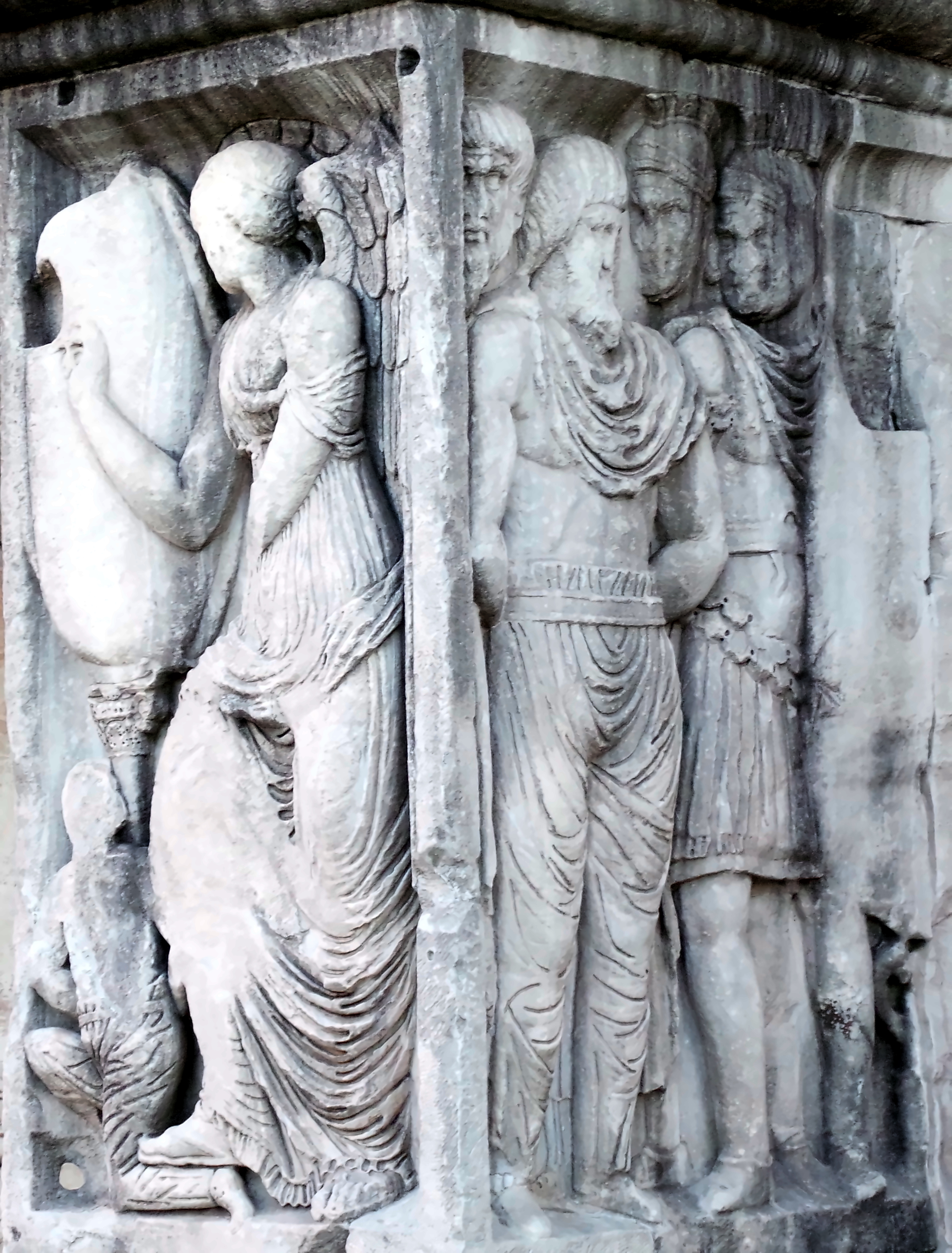
Eight statues of captured Dacian prisoners standing atop the Corinthian columns framing the attic level of the arch. Taken from the Forum of Trajan, these over-life-size figures depict barbarian captives in characteristic Dacian dress — beards, long hair, belted tunics, and trousers. Carved from distinctive purple-veined pavonazzetto marble, they symbolize Roman military dominance and were recontextualized to glorify Constantine's victories.
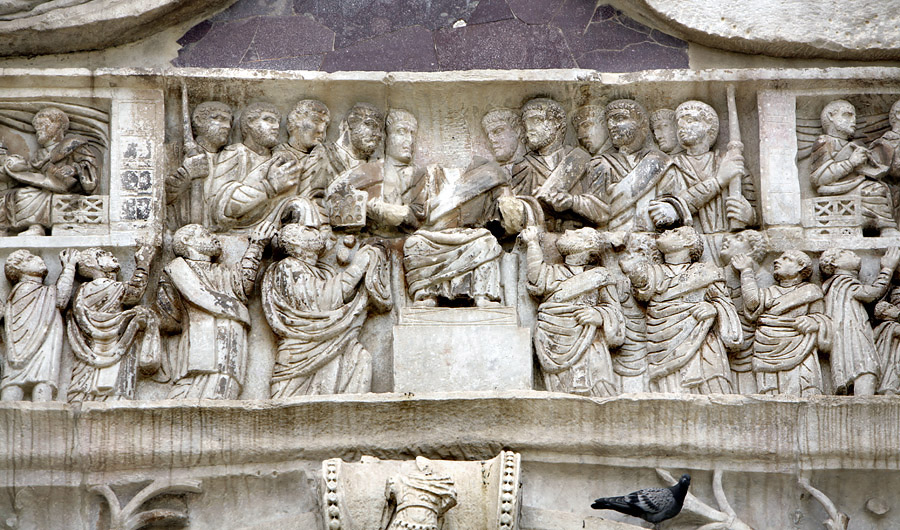
Constantinian Frieze (South and West Sides: Departure from Milan, Siege of Verona, Battle of the Milvian Bridge) Self-researched
The horizontal frieze running below the Hadrianic roundels is the primary Constantinian-era sculptural contribution, depicting scenes from Constantine's Italian campaign against Maxentius. On the west side, the army departs from Milan (Mediolanum). On the south side, the narrative continues with the siege of Verona and culminates in the Battle of the Milvian Bridge, showing Constantine's soldiers on the bridge while Maxentius' troops drown in the Tiber. The style marks a dramatic departure from the classicizing spolia above — figures are stocky with large heads, arranged in rigid frontal rows with minimal spatial depth, reflecting the late antique shift toward hieratic, symbolic representation.

Constantinian Frieze (North and East Sides: Entry into Rome, Oration in the Forum, Largesse) Self-researched
The frieze continues on the east side with the victorious army entering Rome (adventus). On the north side, two panels show Constantine delivering a speech (oratio) in the Roman Forum from the Rostra, and distributing largesse (liberalitas) to the Roman people. These scenes emphasize Constantine's civic virtues alongside his military triumph. The oratio panel notably includes recognizable architectural landmarks of the Forum. The flat, frontal style of these reliefs contrasts sharply with the deeply modeled classicism of the reused 2nd-century panels above them.
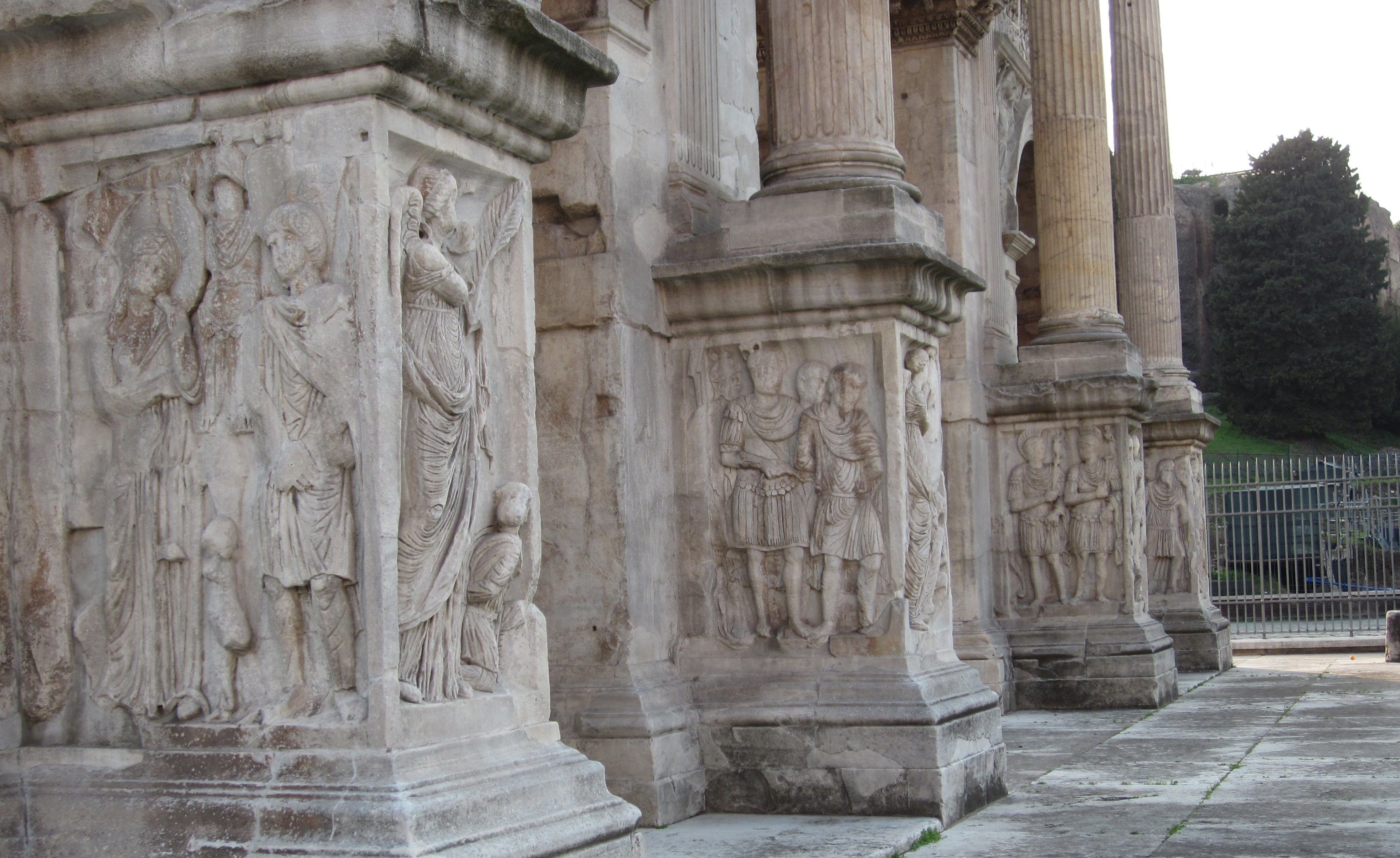
Column Base Reliefs (Victories and Captives) Self-researched
Relief panels on the pedestals of the freestanding columns show Victories carrying trophies, with Roman soldiers and bound captives. These small-scale reliefs echo the triumphal imagery of the arch's larger sculptural program and are executed in the same late antique style as the Constantinian frieze.
Arch of Constantine Self-researched
A triumphal arch dedicated to Emperor Constantine the Great, commemorating his victory over Maxentius at the Battle of the Milvian Bridge in AD 312. Situated between the Colosseum and the Palatine Hill, it is the largest Roman triumphal arch, measuring 21m high, 25.9m wide, and 7.4m deep with three bays decorated with reliefs, many of which were reused from earlier monuments.
