Museo Correr Self-researched
Venice, Italy
Artworks
Jesus giving the Keys to St. Peter Self-researched
A monumental composition with marble throne. Lorenzo Veneziano was the first Venetian painter to move away from Byzantine models toward the Gothic style.
Crucifixion Self-researched
A predella work with traditional composition from one of the founders of the Renaissance style of painting in Venice. Jacopo was the patriarch of the famous Bellini family of painters.
Crucifixion Self-researched
An early career work showing the influence of Andrea Mantegna, Giovanni's brother-in-law. This Crucifixion demonstrates Bellini's development before he achieved his mature style.
Pietà Self-researched
An atmospheric composition echoing Donatello's bronze relief. Part of the museum's significant collection of Bellini family works.
Pietà Self-researched
A significant work demonstrating Tura's monumentality and pathos, bequeathed to the museum as part of Teodoro Correr's original collection in 1830. Measures 47.7 cm by 33.5 cm. Initially attributed to Luca d'Olanda until Vincenzo Lazari recognized it as a Tura work in 1859.

Madonna and Child (Frizzoni Madonna) Self-researched
An innovative depiction featuring the Madonna in an unusual purple gown and pink mantle, departing from the traditional blue. Known as the Frizzoni Madonna.
Pietà Self-researched
The only work by Antonello da Messina remaining in Venice from his 1474-76 stay in the city. Originally housed in the Doge's Palace. This work was influential in introducing Flemish oil painting techniques to Venice.
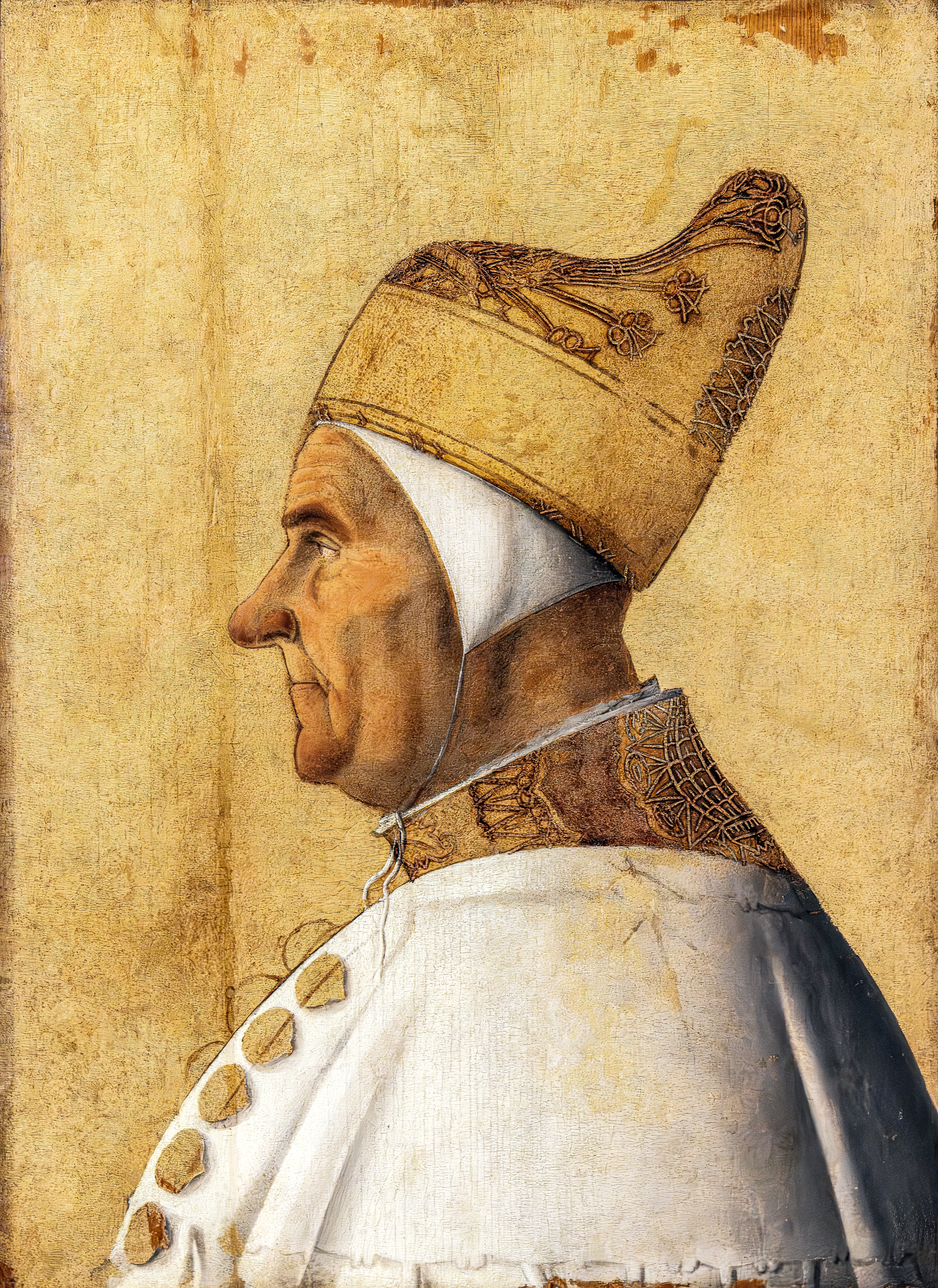
Portrait of Doge Giovanni Mocenigo Self-researched
A profile portrait of Doge Giovanni Mocenigo demonstrating Gentile Bellini's skill as the official portrait artist for the Doges of Venice. Giovanni Mocenigo served as doge from 1478 to 1485.

Doge Giovanni Mocenigo
Portrait of the Doge Giovanni Mocenigo. Gentile Bellini was the official portrait artist for the Doges of Venice from 1474.
Transfiguration of Christ Self-researched
Likely originally from San Salvatore or San Giobbe church. One of several works in the museum representing Giovanni Bellini's mature period.
Two Venetian Ladies Self-researched
A famous painting showing two unknown Venetian ladies on a terrace with dogs, birds, and various symbolic objects. Believed to be a quarter of the original work; the top portion, called Hunting on the Lagoon, is now in the Getty Museum. Once thought to depict courtesans, the work is now believed to show two patrician women awaiting the return of their husbands from a hunting expedition.

View of Venice Self-researched
A monumental woodcut print showing a bird's-eye view of Venice from the southwest, also known as the de' Barbari Map. The museum houses the six original wooden printing blocks. When printed on six large sheets, the composite image measures approximately 135 cm × 280 cm, making it one of the largest prints of its time.

Madonna and Child with Angels Self-researched
Spiritual, meditative figures set in a landscape. Lotto's distinctive psychological approach to religious subjects is evident in this work.
Last Supper Self-researched
An early work by El Greco from his Venetian period, before he developed the more elongated and dramatic style for which he became famous. The painting shows the influence of Venetian masters during his formative years.

St. Peter Martyr Self-researched
A late work by Carpaccio, originally part of a polyptych from Santa Fosca church.
St. Anthony of Padua Self-researched
A refined, elegant work still in its original frame. Alvise was the leading Venetian artist before Giovanni Bellini.
Madonna and Child with St. Nicholas and St. Lawrence Self-researched
Features Cima's characteristic atmospheric handling with a bright palette. His tranquil, luminous style shows the influence of both Bellini and Antonello da Messina.
Madonna, Child and St. John the Baptist Self-researched
A recently confirmed early work by Carpaccio, demonstrating his developing style before the major cycles for which he became famous.
Madonna and Child Self-researched
A work in the International Gothic style with a refined palette. Giambono designed the mosaics of the Birth of the Virgin and Presentation in the Temple.
Madonna and Child Self-researched
Features pearls and coral symbolizing the virgin birth and Christ's sacrifice. Demonstrates Flemish influence in the Venetian collection.
Madonna and Child Self-researched
One of two Madonna and Child paintings by Bartolomeo Vivarini in the collection, representing the transition from Late Gothic to Early Renaissance in Venice.
Genealogy of Christ, with the Life of Christ and the Virgin Self-researched
A complex symbolic work showing Giotto's influence. Paolo Veneziano was the founder of the Venetian School and official painter of the Venetian Republic.
The Adoration of the Magi Self-researched
A variation of his father Pieter Bruegel the Elder's work with miniaturist detail. Part of the museum's collection of Flemish works.