Apostolic Palace
Vatican City
Architectural style: Renaissance, Baroque
Artworks
Philosophy (The School of Athens)
The building depicted is not a real one but an invention. The statues in the left and right are Apollo and Minerva, gods of the arts and wisdom. In the center stand Plato and Aristotle: - **Aristotle** holds his Nicomachean Ethics, which stresses the rational nature of humanity and the need for moral behavior. His hand is placed horizontally to indicate the earth is the source for his observation. - **Plato** holds his Timaeus, in which he describes the origin of the universe. He points upward to indicate that his ideas come from the realm of the mind. Key figures identified: - **Socrates** is in a green robe at the left of Plato - **Pythagoras** at the lower left demonstrates his system of proportions - **Ptolemy** at the extreme right contemplates a celestial globe - **Euclid** at the left of Ptolemy bends down to draw a circle—this is a portrait of Bramante - At the extreme right, **Raphael** painted a self-portrait looking out - In the foreground sits a lonely man with 16th century stone cutter boots—a portrait of **Michelangelo**

Poetry (The Parnassus)
Apollo in the center leads a band of writers that includes Dante, Homer, and Sappho. The fresco celebrates poetry and represents Mount Parnassus, the mythological home of the Muses.

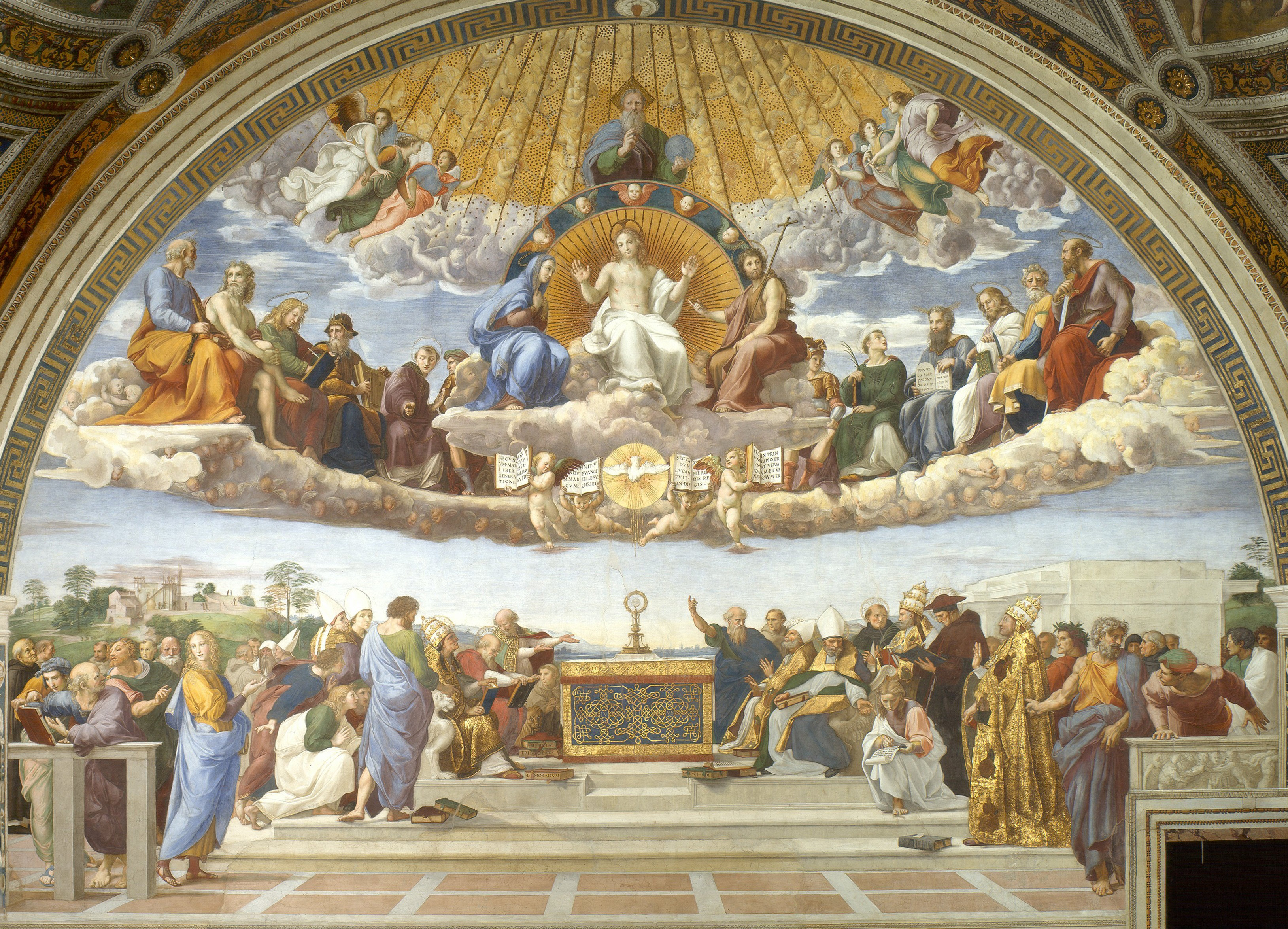
Disputa
Also known as the "Disputation of the Holy Sacrament," this fresco depicts the Church's triumph over heresy. The composition is organized in two zones: the heavenly realm above with Christ, Mary, John the Baptist, and the saints, and the earthly realm below with theologians debating the Eucharist.
The Expulsion of Heliodorus from the Temple
Depicts the biblical story from 2 Maccabees in which Heliodorus, sent to seize the treasure of the Temple of Jerusalem, is driven out by divine intervention. The fresco was commissioned to assert papal authority over the Church's temporal possessions.

The Cardinal Virtues
Three of the cardinal virtues—Fortitude, Prudence, and Temperance—are personified as statuesque women seated in a bucolic landscape. The theological virtues—Charity, Hope, and Faith—are depicted by putti. Shows Michelangelo's stylistic influence but with less tension.

The Mass at Bolsena
A Bohemian priest who doubted the doctrine of transubstantiation was celebrating mass at Bolsena, when the bread began to bleed in the shape of a cross. Below kneel the officers of the Swiss troops. Pope Julius II appears kneeling in prayer, witnessing the miracle.

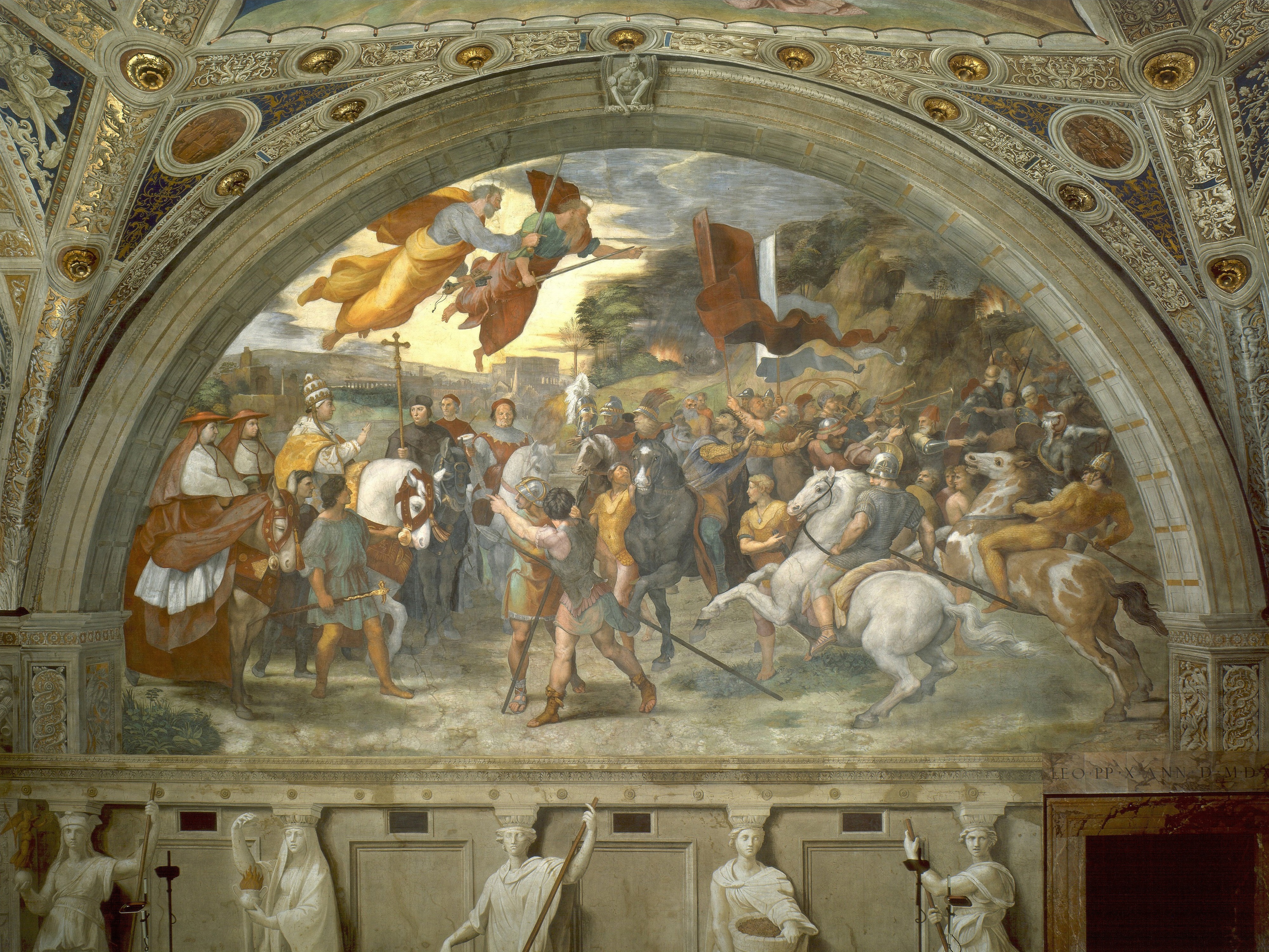
The Meeting of Leo the Great and Attila
Depicts the meeting between Pope Leo I and Attila the Hun, which took place in 452 in northern Italy. Saints Peter and Paul are the ones flying in the sky, shown as divine protectors of the Church who frightened Attila into retreat.
Liberation of Saint Peter
Peter is depicted as a portrait of Julius II. The fresco shows three scenes: the angel appearing to Peter in prison (center), the angel leading Peter past the sleeping guards (right), and the guards awakening to discover Peter's escape (left). Remarkable for its dramatic use of multiple light sources.
