Michelangelo Buonarroti
Born: March 6, 1475, Caprese Michelangelo Died: February 18, 1564, Rome
Italian sculptor, painter, architect, and poet of the High Renaissance. Considered one of the greatest artists of all time. Unlike Leonardo who was skeptical and apolitical, Michelangelo was a believer and loyal Florentine. Where Leonardo looked on the world with detachment, Michelangelo was obsessed by guilt. Spare, taciturn, and irascible, yet consumed with a deep love for others that only in his old age was requited by the adoring reverence of his pupils.
Worked in Ghirlandaio's study at age 13, and was invited into the house of Lorenzo the Magnificent a year later. Scorned landscape, focusing on the human figure.
Artworks
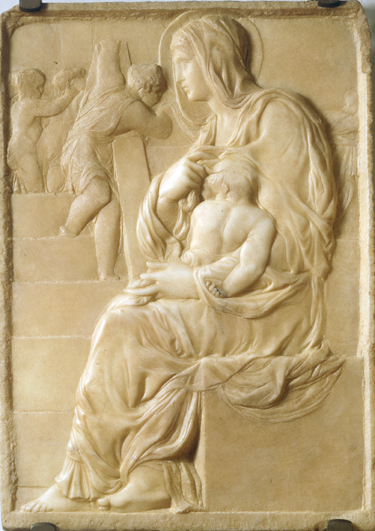
Madonna of the Stairs
An early relief sculpture by Michelangelo, created when he was about 16 years old. Notable for the extraordinary muscular back and right arm of the Christ Child, foreshadowing Michelangelo's later mastery of the human form. The technique shows the influence of Donatello's schiacciato (very shallow relief), which Michelangelo studied during his time in the Medici garden. Despite its small size (55.5 x 40 cm), the composition feels monumental, with the Virgin's powerful, muscular arms and contemplative pose anticipating Michelangelo's mature style. Children play on stairs in the background—hence the name.
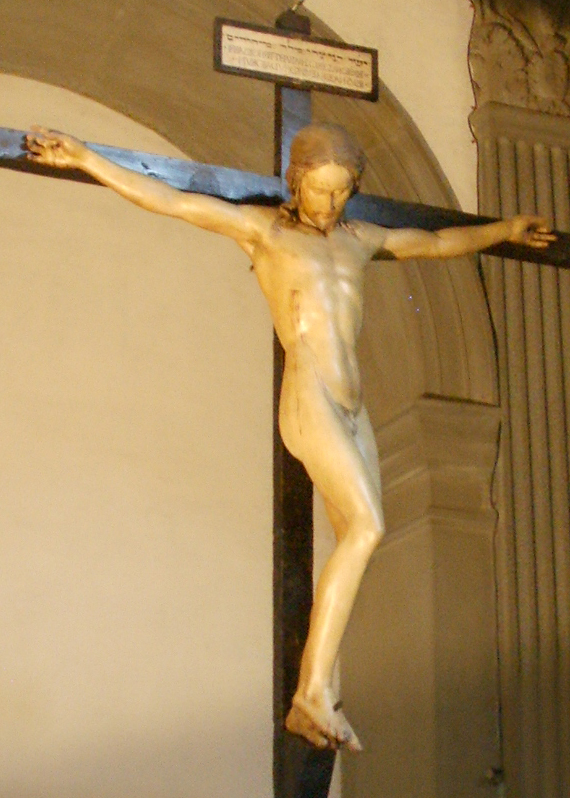
Crucifix
The only wood work we know for Michelangelo. Created for the church of Santo Spirito in Florence. The slender, delicate figure of Christ differs markedly from Michelangelo's later muscular representations.
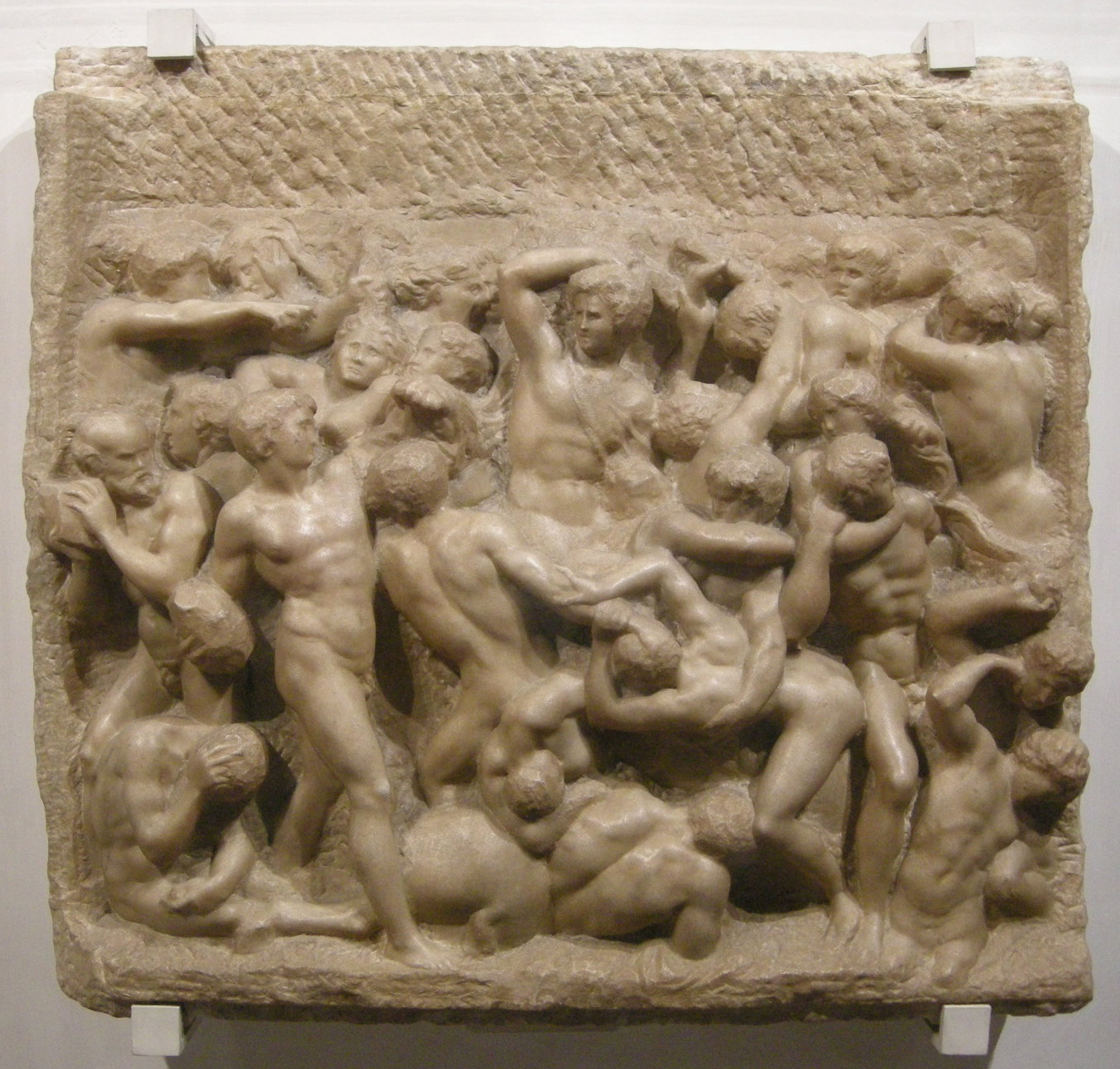
Battle of the Centaurs
A marble relief depicting the mythological battle between the Lapiths and Centaurs, created when Michelangelo was about 17 and living in the household of Lorenzo de' Medici. The dynamic composition of intertwined nude figures demonstrates his early interest in the human form in motion. This was the last work Michelangelo created while under the patronage of Lorenzo de' Medici, who died shortly after its completion. The subject was suggested to Michelangelo by the classical scholar and poet Poliziano, inspired by a classical relief created by Bertoldo di Giovanni. Though unfinished, it demonstrates Michelangelo's fascination with movement and human anatomy that would characterize his mature work.
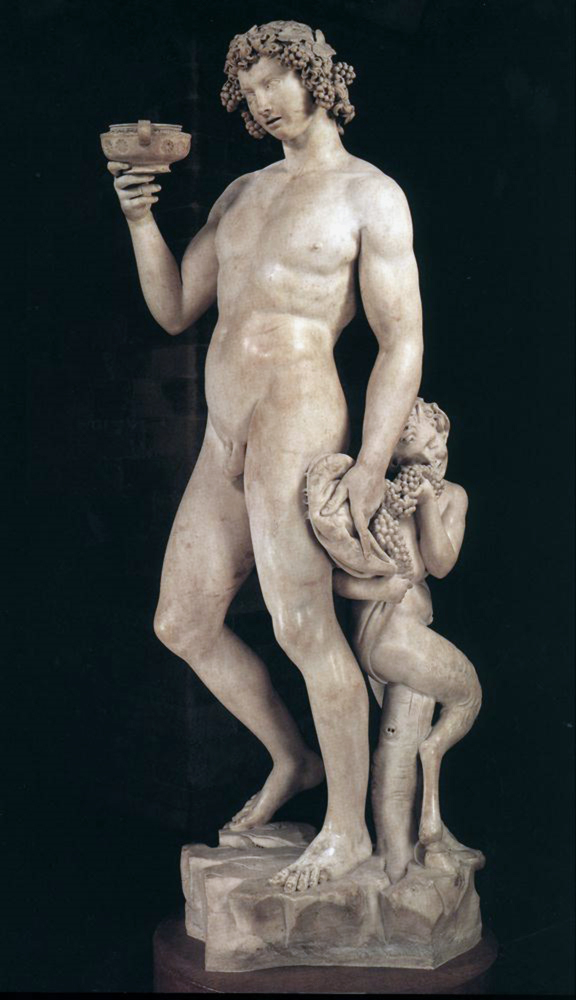
Bacchus
A marble sculpture of the Roman god of wine, depicted nude with vine leaves and grapes, his body swaying as if affected by alcohol. Michelangelo was paid 160 florins for this work. The sculpture demonstrates his ability to capture both classical ideals and naturalistic observation.
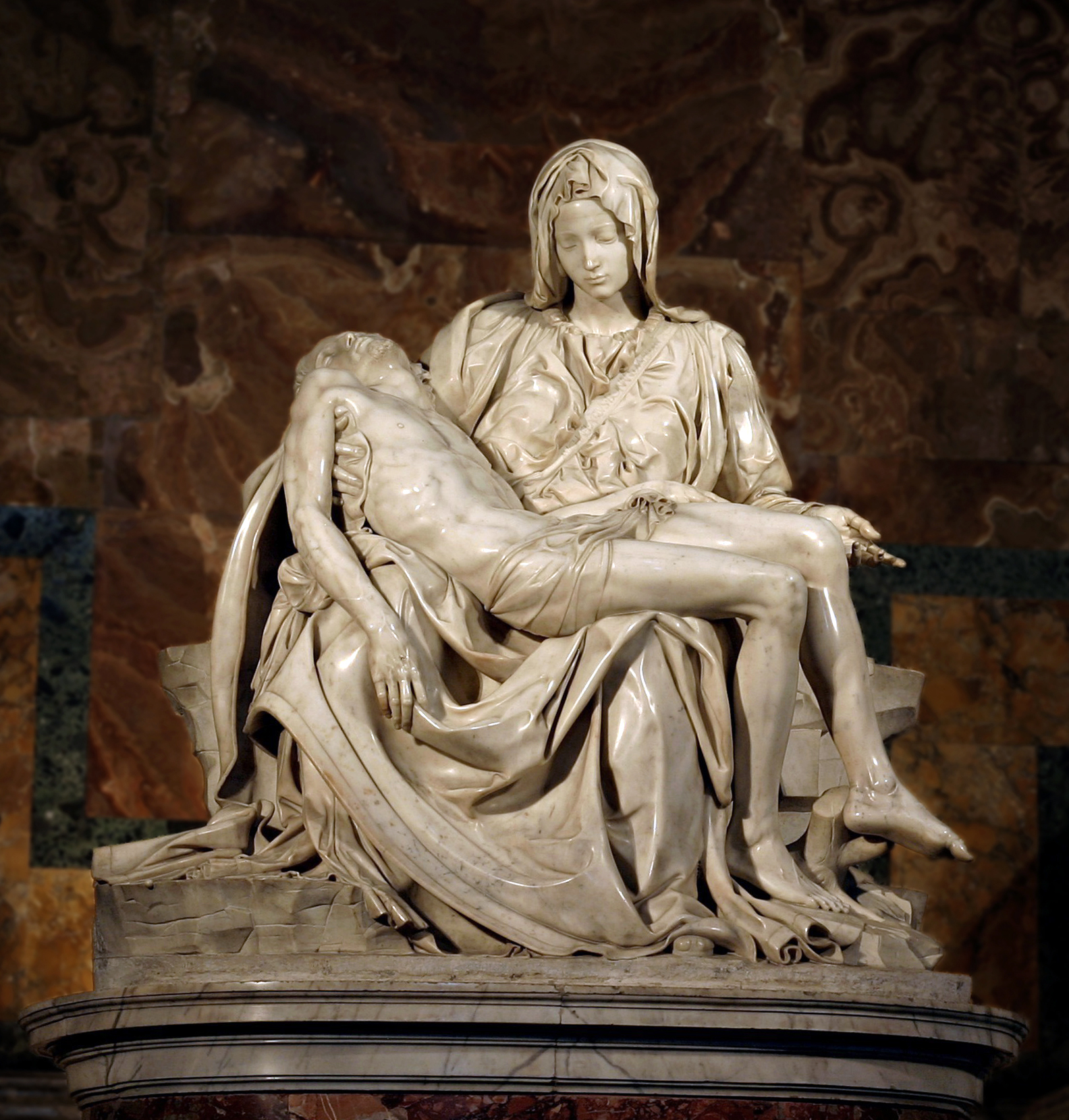
Pietà
Created when Michelangelo was only 23 years old. The sculpture was designed to be placed on or near the floor, so the viewer can see Christ's face better. It is the only work Michelangelo ever signed, reportedly after overhearing viewers attribute it to another sculptor.
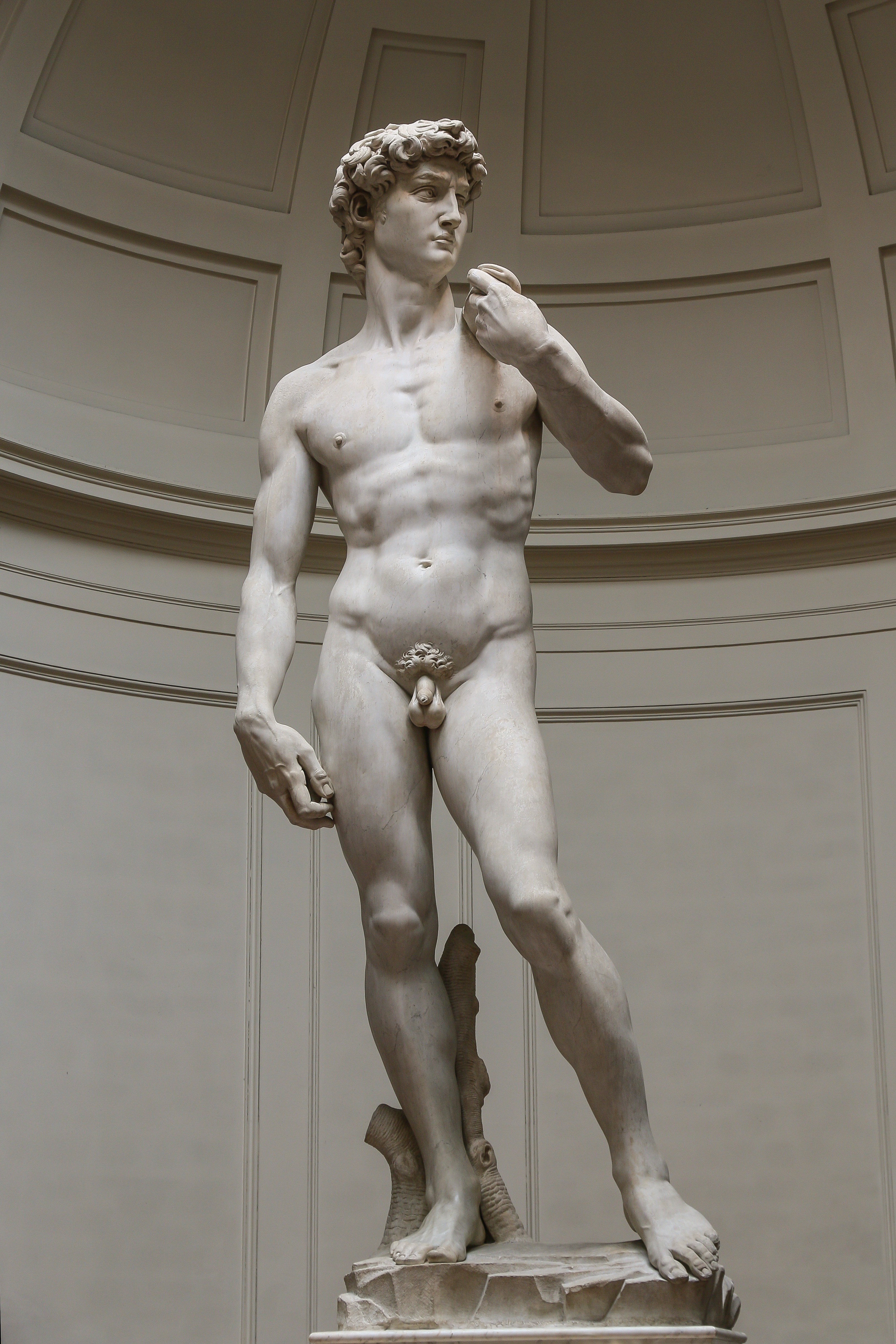
David My Study Self-researched
The commission for Florence cathedral was originally assigned to Agostino di Duccio with a design by Donatello. When Donatello died, the stone was assigned to Michelangelo. The stone was tall but shallow and some work from Agostino had been done already. The statue was designed to be placed on the Florence cathedral's buttress pedestals, on which the boy could look out over the city, gazing to the north. The statue was ultimately placed in front of Palazzo dei Priori (now Palazzo Vecchio). The left arm and hand were damaged in 1527 and preserved by Vasari and Francesco Salviati. The original now stands in the Galleria dell'Accademia, while a replica stands in its original location in Piazza della Signoria.
Battle of Cascina Self-researched
A fresco commissioned for the Palazzo Vecchio to face Leonardo's Battle of Anghiari. Michelangelo only completed the preparatory cartoon before being called to Rome by Pope Julius II. The famous cartoon, showing Florentine soldiers surprised while bathing, was studied and copied by many Renaissance artists before being lost.

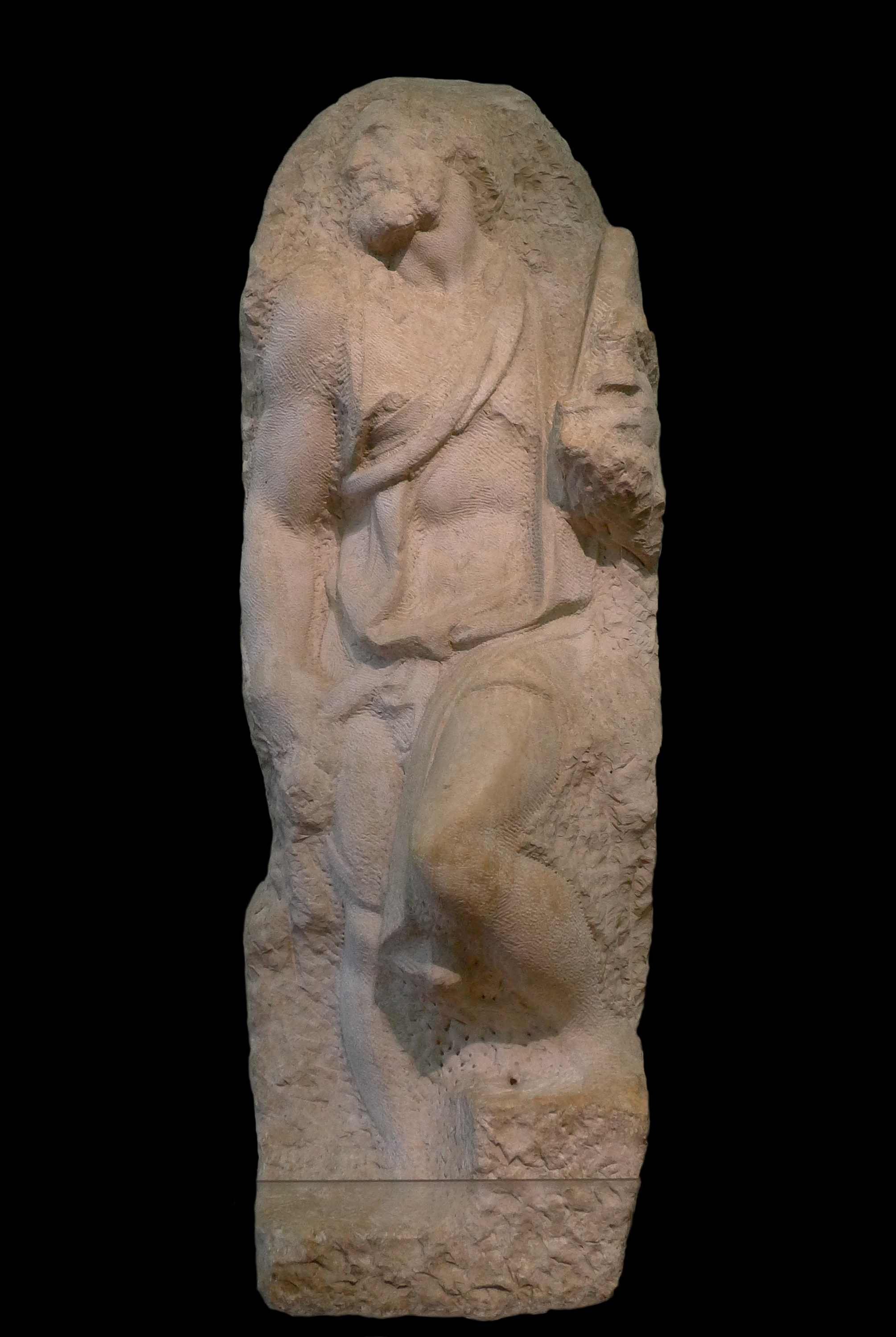
Saint Matthew My Study Self-researched
One of a series of 12 apostle statues commissioned for the interior of the Florence Cathedral (Duomo) that was never begun. This unfinished work shows Michelangelo's sculptural process—the figure appears to be emerging from the block of marble, demonstrating his concept that the sculptor's task is to liberate the form already present within the stone.
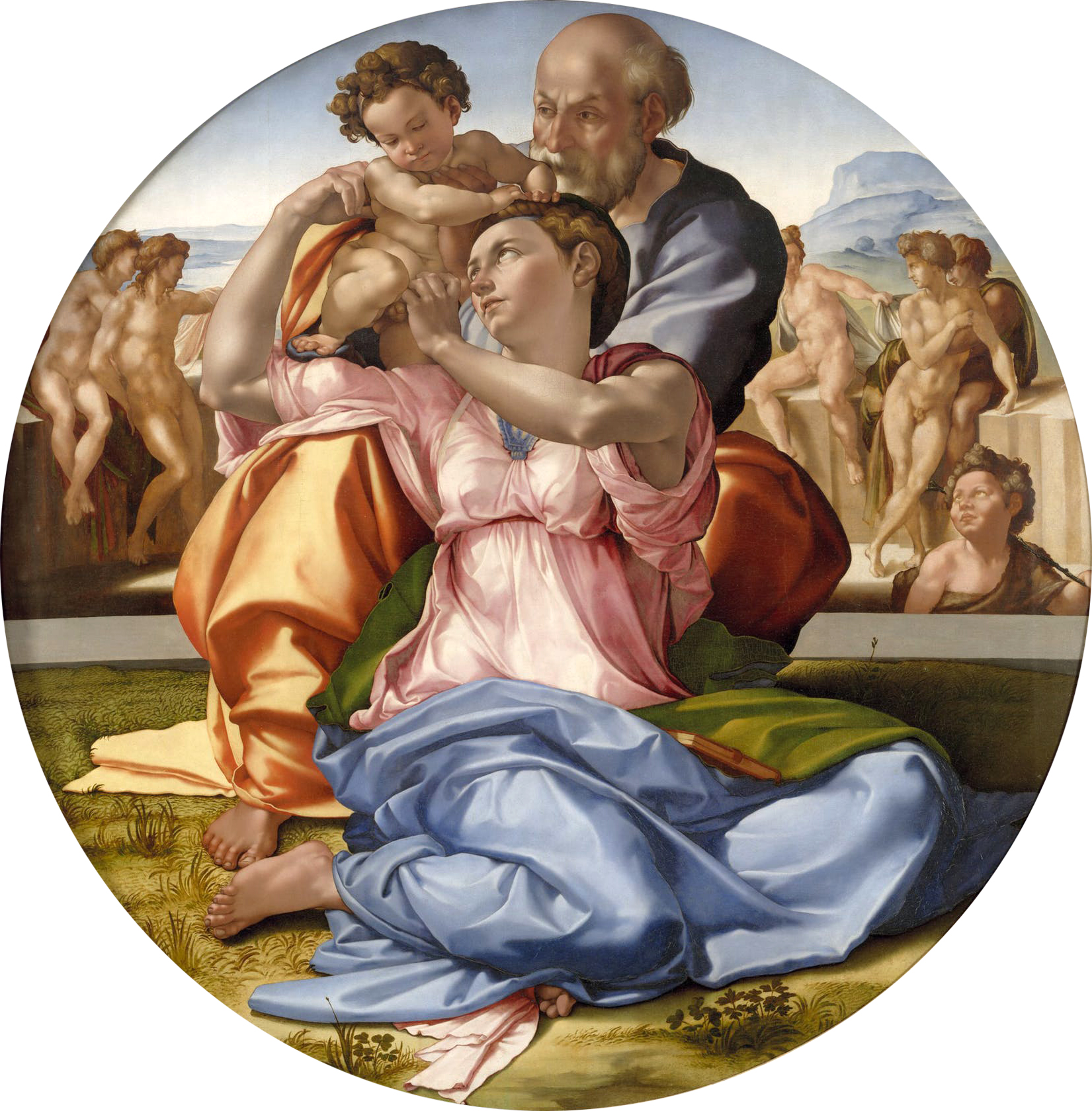
The Doni Tondo
The only preserved panel painting of Michelangelo. Also known as "The Dono Madonna" or "Holy Family with St. John the Baptist," this tondo (circular painting) was commissioned by the wealthy Florentine merchant Agnolo Doni. The unusual poses and vibrant colors influenced later Mannerist painters.
Isaiah
The first prophet to be painted on the Sistine Chapel ceiling. Isaiah turns away from the Flood, which is above and to his left, as if in answer to God's promise: "For to Me this is like the days of Noah, when I swore that the waters of Noah would never again cover the earth. So I have sworn that I will not be angry with you or rebuke you." (Isaiah 54:9) One of seven Old Testament prophets depicted on the ceiling, alternating with five sibyls (pagan prophetesses).

The Flood
Completed in 29 days. The scene shows the devastating flood waters rising as people desperately seek safety. The father carries the body of his drowned son—a powerful image of loss and divine judgment. One of the central narrative panels on the Sistine Chapel ceiling.

Creation of Adam
Completed in 17 days. Painted after the successes of Julius II's army, with an increase in figure size compared to earlier scenes. God, absent from the first four scenes and standing on earth in the Creation of Eve, now moves through heaven in the last four scenes. The near-touching fingers of God and Adam has become one of the most replicated religious images in history. The composition shows the reclining Adam receiving the spark of life from God, who floats in a billowing cloak surrounded by angels.

Fall of Adam and Eve and Expulsion
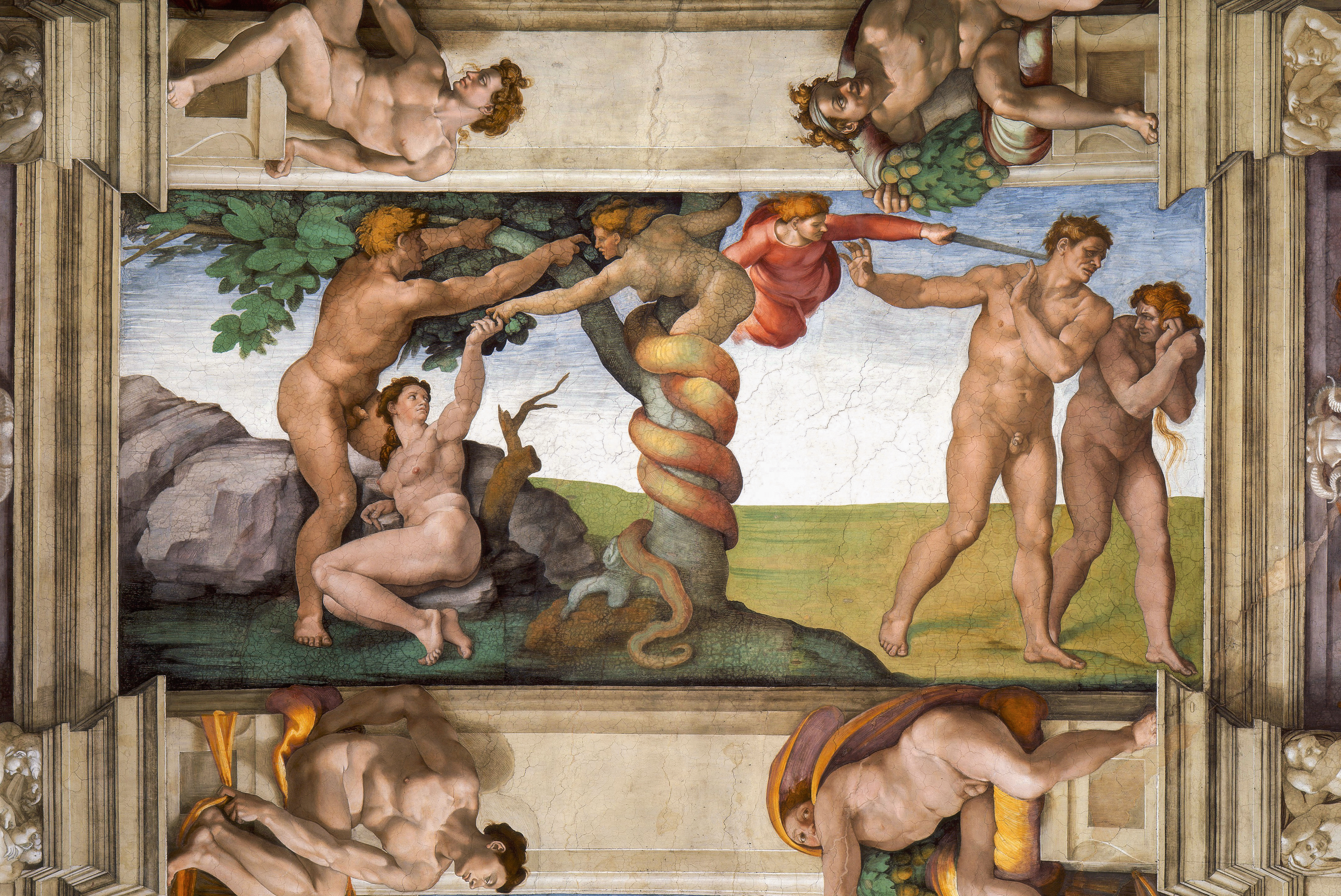
Completed in 13 days. Previously the Temptation and Expulsion had been depicted separately, but Michelangelo united them in the same fresco. On the left, Adam and Eve reach for the forbidden fruit offered by the serpent (depicted with a woman's torso); on the right, an angel drives them from Paradise. The contrast between their idealized bodies before the Fall and their aged, shamed forms after is striking.
David and Goliath
One of the corner spandrels of the Sistine Chapel ceiling, depicting Old Testament scenes of salvation. Central interlocked figures create a clear narrative event—David is shown at the moment of striking down the giant Goliath. The dramatic composition emphasizes the physical struggle between the two figures.

Libyan Sibyl
One of five sibyls (pagan prophetesses) depicted on the Sistine Chapel ceiling, alternating with seven Old Testament prophets. The Libyan Sibyl is shown in a complex twisting pose, reaching for a large book. The light from the Separation of Light from Darkness falls onto the pages of the open book she holds. The figure demonstrates Michelangelo's mastery of the human form, with powerful musculature visible beneath flowing drapery.

Creation of Sun, Moon and Plants
Completed in 7 days. Shows God creating the sun and moon with outstretched arms, commanding the celestial bodies into existence. In the same panel, God is shown a second time from behind, creating the plants. This dual depiction of God in one scene is a compositional innovation.

The Brazen Serpent
One of the last of Michelangelo's works on the ceiling, located in a corner spandrel. Shows more complex groupings of interlocking figures than earlier works. The Israelites writhe in agony from the serpent bites, while those who look upon the bronze serpent that Moses has raised are healed. This scene was traditionally understood as a prefiguration of Christ's crucifixion, as referenced in John 3:14: "As Moses lifted up the serpent in the wilderness, even so must the Son of Man be lifted up."

Separation of Light from Darkness
Completed in 1 day—the fastest execution of any panel on the ceiling. The only scene that is presented as if viewed from below, with dramatic foreshortening of God's figure. This is the first act of creation, showing God's hands separating the primordial light from darkness.

Moses
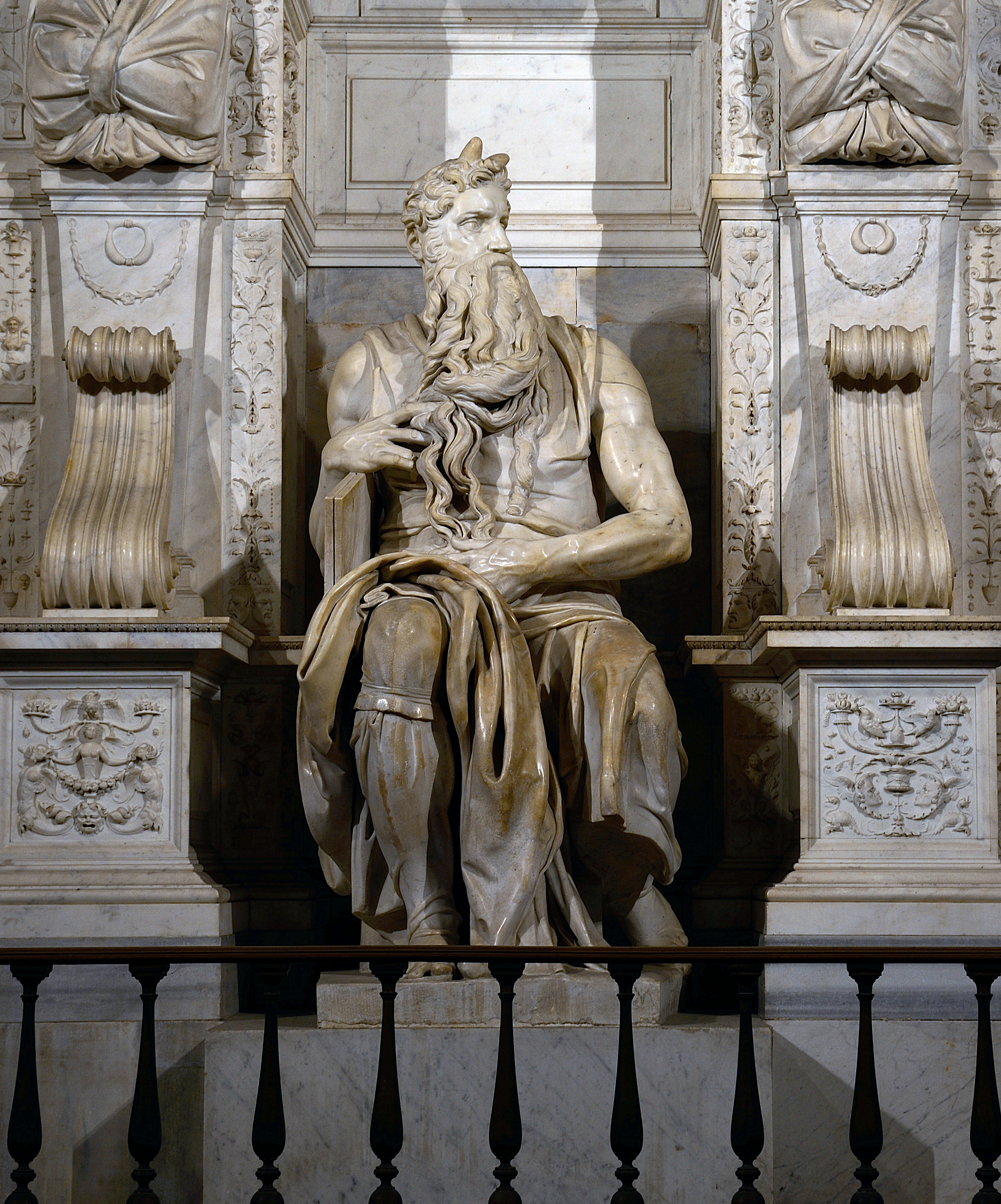
Moses holds the Tablets of the Law. Part of the tomb of Pope Julius II, though the tomb was never completed as originally designed. The left arm repeats almost the same pose as the Cumaean Sibyl in the Sistine Chapel. The face looks similar to the God figure in the Creation of Sun, Moon and Plants in the Sistine Chapel. The horns on Moses' head derive from a mistranslation in the Latin Vulgate Bible, where the Hebrew word for "rays of light" was rendered as "horns" (cornuta). Moses is depicted at the moment of descending from Mount Sinai, about to discover the Israelites worshipping the Golden Calf.
Medici Chapels Self-researched
Two chapels built between the 16th and 17th centuries as an extension to the Basilica of San Lorenzo. They are the Sagrestia Nuova (New Sacristy), designed by Michelangelo, and the larger Cappella dei Principi (Chapel of the Princes), a collaboration between the Medici family and architects. The purpose of the chapels was to celebrate the Medici family, patrons of the church and Grand Dukes of Tuscany. The Sagrestia Nuova was Michelangelo's first realization of architecture. He served as both architect and sculptor, creating a unified artistic vision. The New Sacristy contains the celebrated Medici tombs with their allegorical figures of Day, Night, Dawn, and Dusk.

Tomb of Lorenzo de' Medici, Duke of Urbino Self-researched
A monumental tomb featuring a contemplative seated figure of Lorenzo de' Medici, Duke of Urbino, known as "Il Pensieroso" (The Thinker) for his meditative pose with his chin resting on his hand. The allegorical figures of Dawn and Dusk recline on the sarcophagus below. Dawn is represented as a female figure awakening, her expression suggesting melancholy at the new day. Dusk is a weary male figure, also with an expression of profound sadness. Together with the companion tomb of Giuliano, the ensemble represents Michelangelo's meditation on time, death, and eternity.
Young Slave Self-researched
An unfinished marble sculpture from the 'Prisoners' series intended for the Tomb of Julius II. The youthful figure appears partially trapped in the marble, exemplifying the dramatic tension between form and material that characterizes Michelangelo's unfinished works.

Bearded Slave Self-researched
The most finished of the Florentine Prisoners, named for the thick, curly beard covering the figure's face. Part of the unfinished series intended for the Tomb of Pope Julius II. The clearly defined muscles of the torso reveal Michelangelo's deep study of human anatomy.
Awakening Slave Self-researched
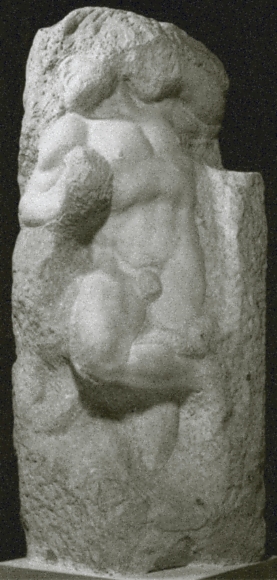
A 2.67m high unfinished marble statue, one of the 'Prisoners' series for the tomb of Pope Julius II. The figure appears to be struggling to emerge from the stone, dramatically illustrating Michelangelo's belief that the sculptor's task was to liberate the figure already present within the marble block.
Atlas Slave Self-researched
A 2.77m high unfinished marble statue, one of the 'Prisoners' series originally intended for the tomb of Pope Julius II. The figure appears burdened by a massive weight on his head, giving the sculpture its name. After Michelangelo's death, it was given to Grand Duke Cosimo I and installed in the Boboli Gardens until 1909.

Tomb of Giuliano de' Medici, Duke of Nemours Self-researched
A monumental tomb featuring an idealized seated portrait of Giuliano de' Medici, Duke of Nemours, with the allegorical figures of Night and Day reclining on the sarcophagus below. The 1.68m-tall marble sculpture forms part of the decorative scheme of the Medici Chapel in San Lorenzo. Night is represented as a sleeping female figure with symbols of sleep (owl, poppies, mask), while Day is a muscular male figure turning away, his face left unfinished. According to Michelangelo's disciple Ascanio Condivi, the sculptures "signify Day and Night and, in conjunction, Time which devours all things."

The Genius of Victory Self-researched
A marble sculpture measuring 2.61m in height, originally produced as part of the design for the tomb of Pope Julius II. The work depicts a young winged male figure standing triumphantly over a crouching older figure. It now stands in the Salone dei Cinquecento.

Brutus Self-researched
A marble bust of Marcus Junius Brutus, the only bust Michelangelo ever made. Commissioned after the assassination of Duke Alessandro de' Medici in 1537, it may represent a republican ideal—Brutus was celebrated in Florence as the slayer of the tyrant Julius Caesar. The bust shows Brutus turning sharply to his left, with an intense expression and furrowed brow. The work was left unfinished, like many of Michelangelo's late sculptures, adding to its psychological intensity.

The Deposition (Florentine Pietà) My Study Self-researched
A marble sculpture depicting four figures: the dead body of Jesus Christ newly taken down from the Cross, Nicodemus (said to be Michelangelo's self-portrait), Mary Magdalene, and the Virgin Mary. Originally intended for Michelangelo's own tomb. Now housed in the Museo dell'Opera del Duomo but was earlier in the Duomo itself.

Sforza Chapel Self-researched
Designed by Michelangelo near the end of his life and completed posthumously by Tiberio Calcagni and Giacomo Della Porta. The chapel features an innovative elliptical plan with a three-part vault and curving side apses, representing one of Michelangelo's most forward-looking architectural experiments.